We were finally able to welcome our speaker Janet Niepokojcycka to our meeting.
Janet has done extensive research into the legend of Robin Hood. Her research going back to the 1500’s. Referring to Robin Hood being born in Yorkshire and the various ballads, films, TV and folklore in which of Robin’s story is told, albeit differing largely over the centuries.
She referred to the differing images of Robin and his men over the centuries. Little John, Friar Tuck and Will Scarlet being present in the 1500’s. Alan A’Dale being a recent addition in the story in the1700’s.
Janet found no romantic links to Robin Hood in the earlier records.
In the 1500’s Little John was very much smaller that Robin Hood. In the 1700’s he was much larger.
She showed various images and statues of Robin Hood and the Major Oak Tree in Sherwood Forest where Robin and his men are said to have taken shelter beneath its branches and hidden inside it’s massive trunk. The Major Oak can still be seen in Sherwood Forest, sadly it is now having to be supported by metal props and viewing can only done from a distance.
After taking members through the centuries and the differing versions of the stories of the life of Robin Hood, Janet ended with the story about where Robin Hood died and where his body was laid to rest at Kirklees Priory (where his final arrow fell to earth).
Despite all her extensive research, Janet found no documentary evidence to dispel any of the myths.
Flora Smithies, a society member, gave a talk titled Destination Elland – A Journey of Discovery.
This started with her own story of her early live at Dean Head when a visit to Elland was an adventure. Catching the trolley bus from West Vale to Elland when they visited the dentist twice a year. They would also play a visit to the Market Warehouse. A place where you could get almost anything you required.
Flora then went on to present to members a copy of a document she had been given for the sale of land on the Langdale Estate by Joseph Langdale in 1877. It was the contents of this document that started Flora’s research into how the Langdales of East Yorkshire arrived in Elland. She traced the history of the Langdale family from their routes in East Yorkshire in the 1500’s to their eventual presence as significant landowners in Elland.
The family had businesses and property in London, Elland, East Yorkshire and France.
After intensive investigations through the family generations Flora was able to find the connection to Elland. Marmaduke Langdale married Frances Brooksbank of Warley. Included in the dowry was property and land in Elland. The presence of the Langdale Family can be seen in the names of some of the streets in Elland: Langdale Street, James Street, Catherine Street and Frances Street named after members of the family.
AG introduced the guest speaker for the night, Nigel Grizzard.
Nigel’s talk was entitled “The Local Jewish Entrepreneurs and the Kagans”.
Nigel, himself, is Jewish, was born in Whitechapel, London but came north to work in Bradford and eventually settled in the Jewish district of Alwoodley in Leeds. He researches Jewish heritage and leads Heritage Walks around West Yorkshire.
His talk was intended to be a “two way street”, where he encouraged audience participation to enhance the overall experience of the evening.
He highlighted a number of areas in our locality with Biblical referenced names, for example, Machpelah Terrace and Machpelah Works in Hebden Bridge and Mount Tabor, before moving on to talk about Jewish celebrities who lived and worked locally, and although there were many Jewish families living in the area, there has never been a Jewish community in Calderdale.
Joseph Kagan, the son of Benjamin, was born in Lithuania. They came to live in Elland in the 1930’s and founded Kagan Textiles in 1938. Their first property was Thornton Mills and later built the famous Gannex Mill on Dewsbury Road. Joe Kagan, was later made a Life Peer, Baron Joe Kagan, by his very good friend, Prime Minister Harold Wilson, who, along with the Duke of Edinburgh, was one of the most famous people to be seen regularly wearing one of Kagans waterproof Gannex raincoats. Joe was one of the more well known people to occupy Barkisland Hall. Benjamin’s wife, Miriam, another survivor of the Holocaust, came to live with him in Britain after the war had ended. At the time he died in 1988 at the age of 109, Benjamin Kagan was Britain’s second oldest man.
Other, lesser known local celebrities were mentioned and discussed
He recently visited Heptonstall, where he visited the grave of Sylvia Plath, the wife of former Poet Laureate, Ted Hughes.
Albert Waxman, a Kindertransport Kid, who served in the RAF and eventually became an industrialist and the founder of Waxman International
Albert Max Hurwitz, who was the son of a Rabbi and became a leading Barrister and in 1957 was appointed Recorder of Halifax
Dr Bertram Mann, who was a consultant chest physician at both Halifax General Hospital and Royal Halifax Infirmary; he pioneered much of the work on asbestosis in the 1970’s;
Dr Barry Benster, who was a consultant gynaecologist and local councillor.
Jonathan Silver, who, along with Ernest Hall, was responsible for the regeneration of Dean Clough Mills
Waldemar (Val) Ginsburg, who’s cousin Margaret, was married to Joe Kagan, having survived the Holocaust, came to live in Brighouse with his wife, Ibi; in the 1980’s they visited many schools to educate children about the Nazi persecution of the Jews and the Holocaust and to try to inspire tolerance among young people. In 2005 they were presented to the Queen on the 60th Anniversary of the liberation of Auschwitz.
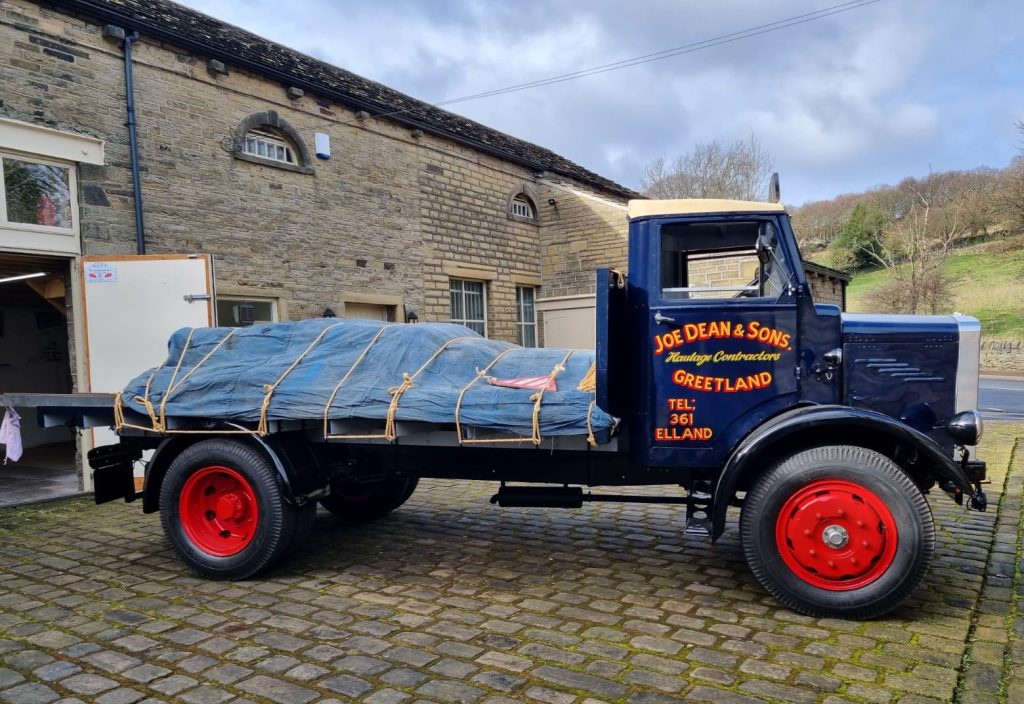
AG introduced the speaker for the night, Alan Dean, who guided us through a slide show on The History of Joe Dean and Sons, Haulage Contractors.
Alan’s Great Grandfather, Joe Dean was a tenant farmer at Far Syke House, located at the junction of Branch Road and Saddleworth Road, Greetland.
The property at that time was rented from the Dyson family. Later, the Dysons sold the property at auction to a butcher from Hull. However, very shortly afterwards, he sold it on to Joe Dean. He, later, built the terrace of four houses at the end of Branch Road for members of his family for the princely sum of £600.
As well as the usual farming activities, they ran a haulage business using wagons and horses and would often travel to Appleby Horse Market to buy horses which they would then walk back to Greetland over a period of several days. Some of the horses would be sold on to other local farmers.
Joe and Edna Dean had four children, including Alan’s Grandfather and the driving force behind the haulage business, Joe Willy Dean.
Joe Willy persuaded his father to buy their first petrol powered wagon, which he himself drove. In June 1915 he volunteered for the Army, he was called up in 1918, but did not see active service and was demobbed in October 1919. He then persuaded his father to buy a fleet of petrol wagons. At that time a lot of haulage firms started up, buying up and using Army surplus vehicles.
The business was diverse, transporting a lot of products and materials for the textiles industries which were thriving locally, partnering with companies such as Binns and Sons, pulling rags to make shoddy for export, Elland Dying Company, when every Friday they would take a full load to Dundee, they worked on roads for WRCC, and they were also coal merchants, but this ended when the cost of maintaining coal tipper wagons became too much.
The day to day farming business continued, cattle being bought and sold at market (and then bought back as meat from the butchers a few weeks later), and hay making during the summer months – happy days.
As the business prospered, a new garage was built in 1947. Although the structure was sound, the roof was constructed on the cheap and leaked until Alan had it repaired many years later.
Eventually, they started using articulated wagons to attract more lucrative work. There was never a shortage of work for haulage companies and they often had to use subcontractors to meet the demand.
They carried a lot of cotton yarns to knitters in the Midlands, transported quarried rock for Marshalls at Southowram, plastics for Synlon Plastics, heavy engineered products and fabrications for the likes of James Lumb, Hopkinson Valves and Portland Engineering.
They developed a very good relationship with their neighbouring business, Bondina/Freudenberg and on many occasions provided them with wagons for them to dress up as floats for local events. And because of their Auntie’s connection with the Girl Guides, they also provided this same service whenever the Halifax and Elland Carnivals were on.
Alan’s many slides and narrative proved to be a joy to all who attended, bringing back very happy memories of days gone by in our small corner of the world.
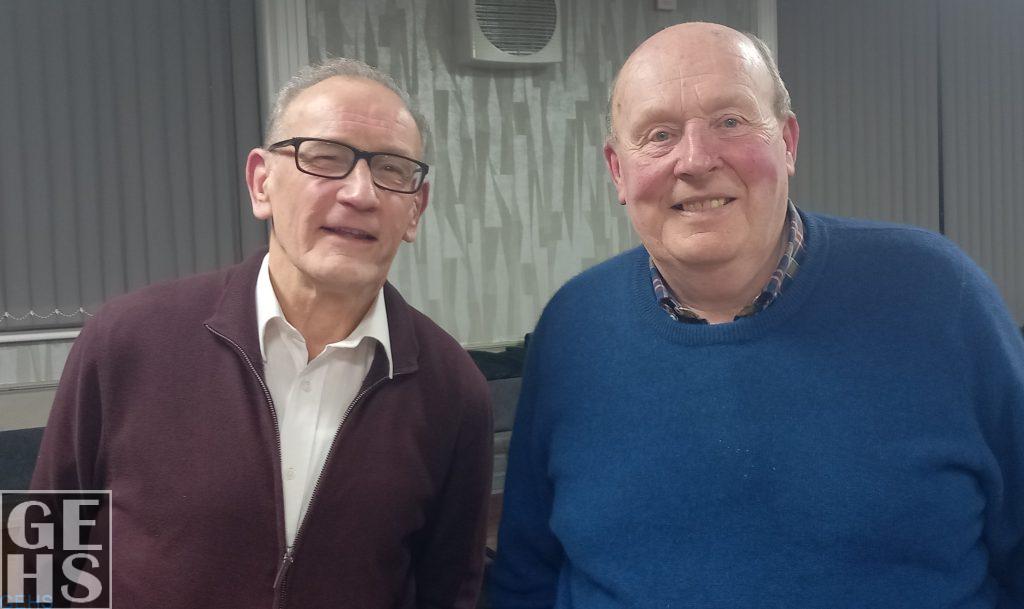
GEHS Member Mr Andrew Ryland with Mr Alan DeanPhotograph by courtesy of Mr Alan Dean